
Nyungwe National Park protects 13
primate species, making it one of the best places in Africa for monkey and
ape viewing. This includes chimpanzees, a 400-strong troop of black-and-white
colobus monkeys, L'Hoest's monkeys, mangabeys, and several other monkey
species. Some are common and easy to spot along trails, while others like the
owl-faced monkey are rare and take luck to find. The park runs guided tracking
activities for the main species, with permits costing around $150 for
chimpanzee trekking. Guides know the forest well and can help you locate
different groups. You do not need to see all 13 species to enjoy the park even
a few sightings make for a good visit. Most primates are active during the day,
except for bush babies, which come out at night.
1. Eastern
Chimpanzee (Pan troglodytes schweinfurthii)
Chimpanzees are the only great apes living in
Nyungwe, with a population of about 500 individuals . Two groups are fully
used to people for trekking: the Mayebe community and the Cyamudongo group,
which lives in a separate forest patch . A third group at Gisovu is partly
habituated, while another at Kamiranzovu is still being trained for
visits . Seeing them takes early morning starts and some hiking, as they
move daily to find fruit and leaves. They are smart animals that use tools and
live in large family groups. You get one hour with them once located. Trekking
permits cost $150, and you need to book ahead, as spots are limited. Children
under 15 cannot take part.
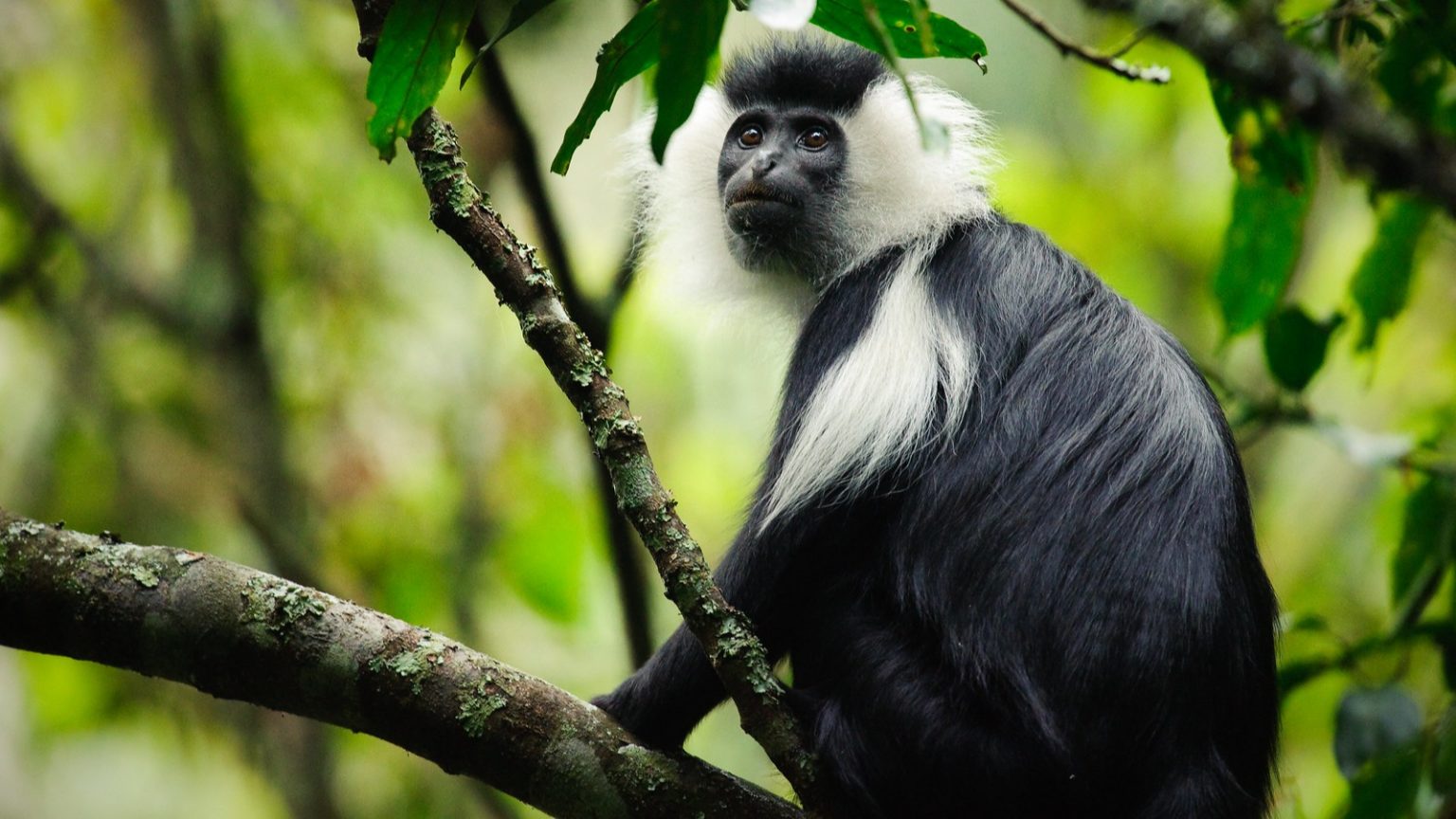
2. Rwenzori
Black-and-White Colobus (Colobus angolensis ruwenzorii)
This monkey is easy to notice because of its black
body and long white tail hairs . Nyungwe holds one of the largest colobus
troops ever recorded, with up to 600 individuals moving together .
Tracking this mega-troop is often easier than chimp trekking because the group
is large and usually stays near the park edge at Gisakura . They feed
mostly on leaves, so they do not move as far each day as fruit-eating monkeys.
You can see them leaping between trees, using their long tails for balance.
This activity suits people who want a shorter trek with good wildlife viewing. Guides
can help you find the troop most mornings .
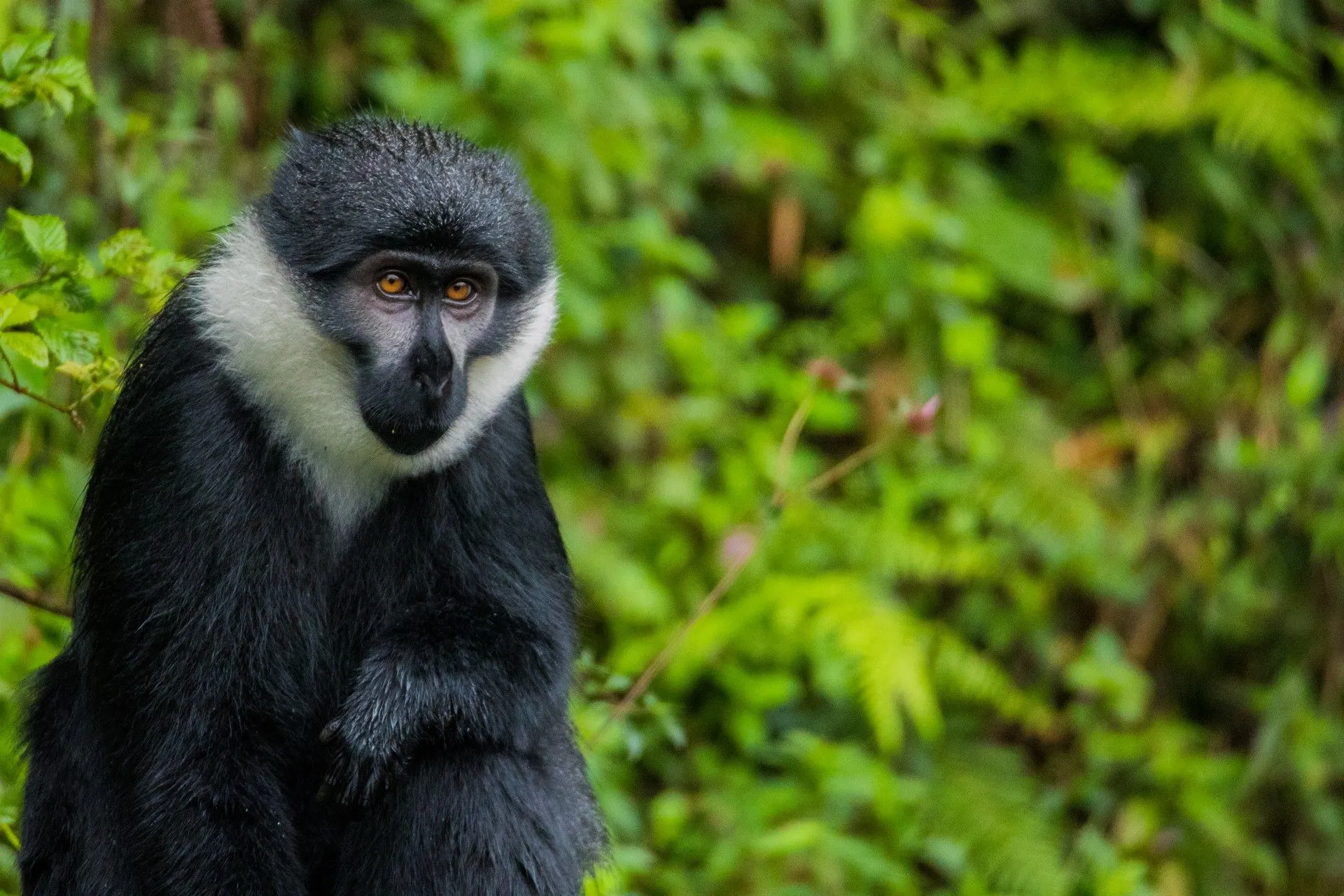
3. L’Hoest’s
Monkey (Cercopithecus lhoesti)
This monkey is native only to the Albertine Rift
region, making Nyungwe a special place to see it . It has a dark grey coat
and a clear white beard under its chin . Unlike many forest monkeys, L’Hoest’s
monkeys spend a lot of time on the ground, which makes them harder to
spot . They live in small groups usually led by one male, with females
staying together for life. Their diet includes fruit, leaves, and insects. They
tend to be shy and will hide if people come too close. You are more likely to
see them on quiet forest trails rather than during busy trekking sessions.
These monkeys are considered near-threatened, so seeing them in the wild is a
good sign for conservation.
4. Silver Monkey
(Cercopithecus mitis doggetti)
This is a type of blue monkey found only in this
part of Africa . They have a greyish-silver coat, which is lighter than
the related blue monkey, and their faces are dark with a white patch on the
forehead. Silver monkeys live in mixed groups that often join with other monkey
species for safety . They feed mainly on fruit, leaves, and flowers in the
forest canopy. These monkeys are active during the day and move through the
trees with steady, quiet movements. They can be seen along many park trails,
especially in the morning. Tracking them is not as popular as chimp or colobus
trekking, but they offer a good chance to see monkey social behavior.
5. Blue Monkey
(Cercopithecus mitis)
Blue monkeys are common across Nyungwe and are named
for their dark grey-blue fur, though it can look more grey in some light .
Their faces are black with a pale blue patch around the eyes. They stay in the
forest canopy, feeding on fruit, leaves, and small insects. Groups can be
large, up to 40 individuals, and they often mix with red-tailed monkeys. These
monkeys are not shy and can be spotted along many hiking trails. They are
active in the early morning and late afternoon. If you are on a general nature
walk, you have a high chance of seeing them. Their loud calls help guides find
them easily.
6. Grey-Cheeked
Mangabey (Lophocebus albigena)
Mangabeys have dark grey fur, lighter grey cheeks,
and a golden mane around their necks . They are fully habituated in
Nyungwe, meaning you can track them with a guide . They live in groups of
5 to 30, with males leaving the group when they reach maturity . They are
arboreal, spending most of their time in the treetops eating seeds, fruit, and
figs. Their powerful jaws let them crack open hard nuts that other monkeys
cannot eat. They are noisy and active, so you often hear them before you see
them. Tracking them is less physically demanding than chimp trekking, as their
home ranges are smaller.
7. Red-Tailed
Monkey (Cercopithecus ascanius)
This small
monkey is named for its reddish tail and has a white spot on its nose .
They are among the most playful and active primates in the park, often mixing
with blue monkeys to form mixed-species groups . This mixing gives them
extra protection from predators. They feed on seeds, fruit, flowers, and
insects. They move fast through the trees and can be hard to photograph but are
very fun to watch. You can see them from the canopy walkway or along many
forest trails. Their quick movements and calls make the forest feel active and
full of life.
8. Olive Baboon
(Papio anubis)
Baboons are the largest monkeys in Nyungwe, other
than chimps, and are the only species that spends significant time on the
ground . They have olive-grey fur and dog-like faces with powerful jaws.
They live in large troops with a clear social order. Unlike other monkeys in
the park, baboons are adaptable and eat almost anything, from fruit and seeds
to small animals. They are often seen in more open areas and near the park
edge. They are not as heavily forest-dependent as other species, so you may
spot them along roads or on the edges of tea plantations near the park.
9. Vervet Monkey
(Chlorocebus pygerythrus)
Vervet monkeys are small, with black faces and
greenish-olive bodies . Males are larger than females . They live in
groups and are often seen near the forest edge and clearings. They are common
and adapt well to disturbed areas. They eat fruit, leaves, seeds, and insects.
Their alarm calls are well known because they use different sounds for
different predators. They are active and bold, often approaching lodge areas.
They are an easy primate to see without any special trekking permit, making
them a good choice if you are short on time or have kids in your group.
10. Dent's
Monkey (Cercopithecus denti)
This is a less common monkey in Nyungwe. It is
similar to the red-tailed monkey but has a different face pattern. It is found
in the Congo Basin and parts of the Albertine Rift. Its distribution and
behavior in Nyungwe are less studied, so guides may need extra skill to locate
it. They live in the forest canopy and eat fruit and leaves. Spotting them
requires patience and a good guide. If you are a serious monkey watcher, ask
your guide to help you look for this species on quieter trails. It is not
targeted for standard trekking but may be seen as a bonus during other forest
walks.
11. Owl-Faced
Monkey (Cercopithecus hamlyni)
Also called Hamlyn's monkey, this rare species has a
white stripe running down its nose, giving it an owl-like face . It is
native only to the Albertine Rift and is considered endangered . It is
very shy and hard to find, living in small groups in the forest . They
feed on bamboo shoots, fruit, and other vegetation . Because they are so
rare, seeing one is special but not something you can count on. Your guide will
need luck and experience to find them. They are not a target for regular
trekking activities. If you want to try, plan for a full day with a guide who knows
their preferred habitat.
12. Golden
Monkey (Cercopithecus mitis kandti)
This is a subspecies of the blue monkey, with a
golden-orange patch on its back and sides. They are more famous in Volcanoes
National Park, where they are tracked, but they also live in Nyungwe .
They feed on bamboo and forest fruit. In Nyungwe, they are less common and can
be hard to find. They live in small family groups and are active during the
day. You may see them in bamboo zones if you are on the right trail. They are
not part of the main tracking activities. Seeing them is a bonus for birders
and hikers exploring different habitats. Ask your guide about recent sightings
to increase your chances.
13. Bush Baby
(Galago species)
Bush babies are small, nocturnal primates with large
eyes and long tails. They are not seen during the day. They come out at night
to feed on insects, gum, and fruit. They move fast through the trees by
leaping, using their strong legs. At night, you may hear their loud, crying
calls. You can see them on a night walk near the lodges or along the forest
edge. They are very small, so take a torch with a red filter to avoid
disturbing them. They are the only primate in Nyungwe that is active at night.
This makes them a different experience from all the day-active monkeys and
apes.
Best time to
trek Nyungwe primates on Rwanda safari
The dry seasons from June to September and December
to February are the best times for primate trekking in Nyungwe, as trails are
firmer and less slippery, making hikes easier and shorter. During the rainy
seasons from March to May and October to November, paths become muddy and more
difficult to walk, and heavy rain can make it harder to find the primates and
reduce your time with them. However, Nyungwe is a rainforest, so some rain can
fall at any time; you need waterproof gear and good boots regardless. For
chimpanzee tracking in particular, the drier months offer higher success rates
and better walking conditions.
How to get there
to Nyungwe National park
You can reach Nyungwe by road or air. The most
common way is a road trip from Kigali, which takes about 5 to 6 hours and
covers around 225 kilometers . The drive is comfortable on paved roads,
passing through towns like Huye where you can stop at the Ethnographic
Museum . For a faster option, you can book a domestic flight with RwandAir
from Kigali to Kamembe Airport near Rusizi; the flight takes about 45 minutes
to an hour, followed by a 30–45 minute transfer to the park . If you are
on a budget, public buses to Rusizi are available, but they take about 8 hours
and you will need a local taxi to reach the park entrance . Most visitors
use private vehicles or tour operators for convenience