
A Rwanda
safari with gorillas works best when you build the trip around one fixed
point: the permit. Only 96 gorilla permits exist per day, each costing $1,500,
so you book that before flights, lodges, or anything else. Plan three to four
days minimum, ideally in the dry seasons from June to September or December to
February when trails are firmer. Rwanda is small enough to combine Volcanoes
National Park with Akagera's savannah and Nyungwe's rainforest in a week.
Budget $1,800 to $2,800 for a mid-range three-day trip, add tips and a porter,
buy medical evacuation insurance, train your legs beforehand, and hire a
licensed operator who confirms the permit is in your name.
1. Book your
permit first, before flights.
The gorilla
permit costs $1,500 for international visitors and is non-refundable . Only
96 permits exist per day across 12 habituated families . Peak seasons sell out
months ahead, so secure your date before booking anything else . If you book
flights first and then find no permits, you will be rearranging everything. Use
the official Visit Rwanda portal or a licensed operator who can confirm your
permit is issued in your name
2. Choose dry
season for easier trekking.
June to September and December to February offer
firmer trails and better visibility . The wet seasons from March to May and
October to November mean mud, slippery slopes, and longer hikes because
gorillas move deeper into the forest . Dry season permits disappear fastest, so
book six to twelve months ahead if you want peak months like July or August .
Wet season gives you lower lodge rates and fewer people on the mountain if you
can handle the mud
3. Plan at least
three days, ideally four.
A three-day trip gives you arrival, one trek day,
and departure . That works if you are short on time. But altitude in Volcanoes
National Park sits between 2,400 and 4,500 meters, and arriving a day early
helps your body adjust . A four-day itinerary adds a buffer for flight delays
and lets you visit the Ellen DeGeneres Campus or the Gorilla Guardians village
without rushing
4. Combine
gorillas with other parks.
Rwanda is roughly the size of Maryland, making
multi-park trips practical .
Akagera National Park in the east offers Big Five game drives on savannah
and boat safaris on Lake Ihema . Nyungwe Forest in the southwest has chimpanzee
tracking, colobus monkeys, and a canopy walkway . A seven-day loop covering
Akagera, Volcanoes, and Nyungwe gives you savannah, rainforest, and volcanic
mountains in one trip
5. Budget beyond
the permit.
A three-day mid-range safari runs $1,800 to $2,800
per person, with the permit inside that figure . Budget travelers can find
group tours starting around $1,300, while luxury trips exceed $3,500 . Add $10
to $20 per day for tips, $15 to $20 for a porter, and $50 to $150 for drinks
and souvenirs . Travel insurance with medical evacuation is essential given
limited local facilities
6. Train your
legs before you go.
The trek can
last one hour or five, depending on where the gorillas moved overnight . You
will hike off-trail through stinging nettles and mud at altitude . Start hiking
with a weighted daypack two to three months before your trip . If hiking is not
accessible, use stairs or long walks. You do not need to be an athlete, but you
need endurance for steep, uneven ground.
7. Pack for mud
and nettles.
Long pants and long sleeves protect against thorns
and stinging nettles . Waterproof hiking boots with ankle support are
non-negotiable . Bring gardening gloves for grabbing vegetation, a rain jacket
regardless of season, and insect repellent . Neutral colors are better than
dark ones because tsetse flies are drawn to dark clothing . Leave your nice
clothes at the lodge.
8. Hire a porter
at the trailhead.
Porters cost
$15 to $20 and carry your daypack, steady you on steep sections, and pull you
through mud . Most porters come from communities around the park, and the
income supports local families . Many were former poachers, so porter work
reinforces conservation incentives . Even experienced hikers find the help
valuable. It is the best money you will spend on the trek.
9. Follow the
gorilla rules strictly.
You get
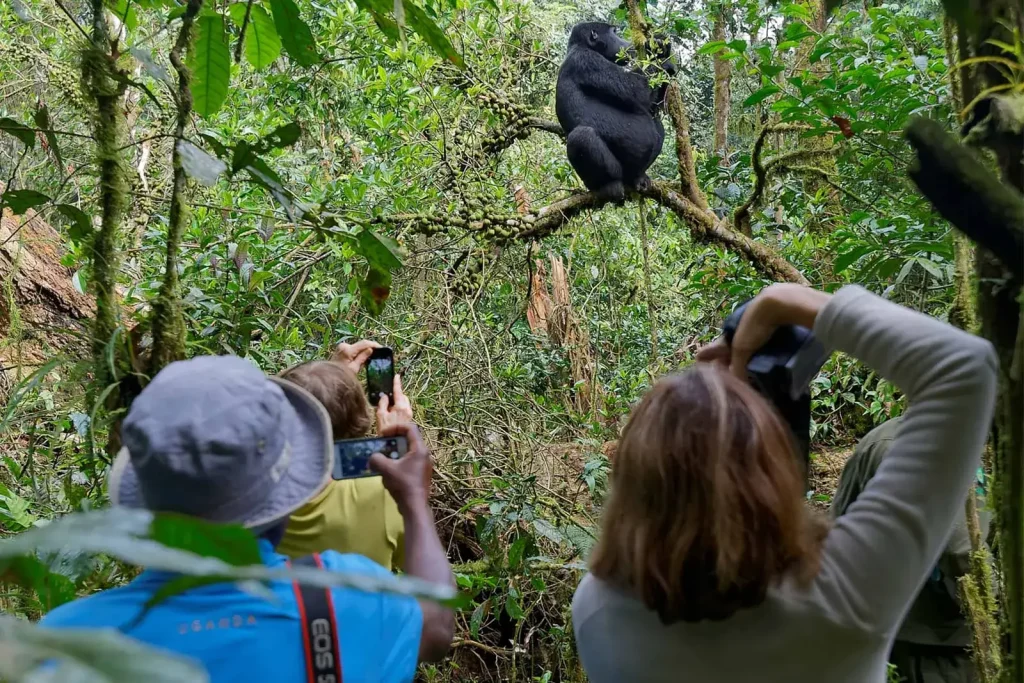
exactly one hour with the gorillas . Stay at least seven meters away, keep your
voice low, and avoid sudden movements . If you have a cold or flu, you will be
denied access because gorillas are vulnerable to human diseases . Wear the face
mask provided . No flash photography . If a gorilla charges or vocalizes, stand
still, look away, and follow your guide
10. Work with a
licensed operator.
Verify the company has a physical address in Rwanda,
membership in tourism associations, and reviews across multiple platforms . Ask
for a written itinerary before paying anything . A legitimate operator will
confirm your permit is issued in your name and provide a clear payment
schedule, usually 30% deposit with balance due 30 to 60 days before arrival .
Avoid anyone demanding full payment to a personal account with no
documentation.