
Gorilla trekking in Uganda and
Rwanda has become one of the world's most coveted wildlife experiences. Only a
few hundred permits exist each day across the two countries, the encounters
last just one hour, and the animals themselves are among the rarest on Earth.
Understanding why this experience captivates travelers so deeply reveals much
about conservation, human connection, and the meaning of wild encounters.
The
Rarity of Mountain Gorillas
Mountain gorillas exist nowhere
else on Earth outside the Virunga Massif and Uganda's Bwindi Impenetrable
Forest. Their total population is estimated at just over 1,000 individuals,
making them one of the planet's most endangered great apes . This extreme
rarity means that seeing one in the wild is not simply a wildlife sighting but
an encounter with a species on the edge of existence. Travelers understand that
the privilege carries weight every trek is a reminder that these animals
survive through intensive conservation efforts, and that the opportunity to
observe them may not exist indefinitely without continued protection.
The
One-Hour Rule and Its Power
Permits grant exactly one hour with
a habituated gorilla family. That limit transforms the experience into
something precious and intensely focused . Unlike a game drive where animals
may appear and disappear across hours, gorilla trekking delivers a concentrated
encounter in which every minute matters. Guides advise putting cameras down
occasionally to simply observe, because the hour passes faster than expected.
The restriction exists to minimize disturbance to the gorillas, but it also
creates a psychological intensity that travelers describe as unlike any other
wildlife experience a bounded, deliberate, and deeply felt hour rather than a
casual sighting.
The
Physical Journey Through the Forest
Reaching the gorillas requires
effort. Treks through Bwindi's dense undergrowth or the Virunga slopes can last
from one to several hours, crossing steep terrain, muddy trails, and thick
vegetation . Porters are often hired to assist, and the hike itself becomes
part of the story. The physical challenge filters out casual tourists and
creates a sense of pilgrimage. When the guide signals that the family is near,
trekkers leave their walking sticks behind, lower their voices, and enter the
gorillas' space on foot. That transition from exertion to stillness is central
to why the experience feels earned rather than merely purchased.
A
Face That Feels Familiar
The moment of eye contact with a
mountain gorilla is the memory most travelers cite above all others. Gorillas
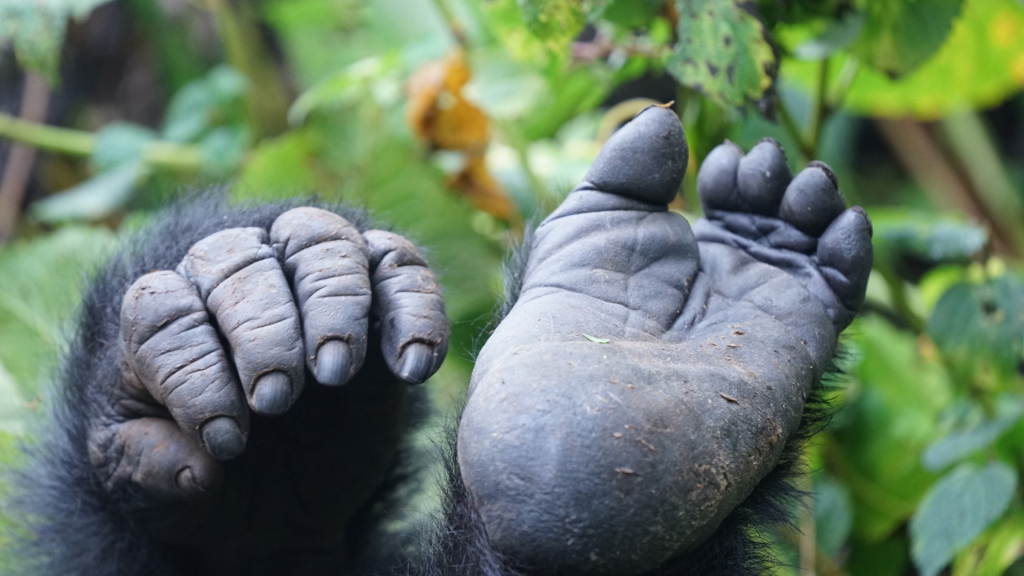
share roughly 98 percent of human DNA, and their faces, hands, and social
behaviors read as startlingly familiar . Infants tumble and play while mothers
watch; silverbacks monitor their families with quiet authority. This kinship
creates an emotional response that transcends typical wildlife viewing.
Travelers often describe the encounter as humbling rather than thrilling a
sense of being observed by a being that recognizes you as something similar,
not merely as a tourist in a vehicle.
The
Silverback and Family Dynamics
Gorilla trekking reveals complex
social structures. Each habituated family is led by a silverback, a mature male
who mediates disputes, protects infants, and decides when the group moves or
rests . Watching a family at ease juveniles wrestling, females grooming one
another, the silverback grazing nearby offers a window into a society with
recognizable rhythms. Trekkers are briefed to maintain distance and avoid
mimicking gorilla sounds, but the proximity still allows observation of
individual personalities. Many guides know each family member by name and can
narrate relationships, turning the hour into a story about specific animals
rather than anonymous wildlife.
Conservation
Value Embedded in the Permit
Permit fees $1,500 in Rwanda and
$800 in Uganda are not incidental costs but the economic engine of gorilla
conservation . Revenue funds anti-poaching patrols, veterinary care, habituated
family monitoring, and community development programs that give local people a
stake in protecting the forest. Travelers increasingly understand that the high
cost is the point: gorilla tourism must outcompete alternative land uses to
survive. This knowledge reframes the expense as a contribution rather than a
luxury, and many trekkers leave feeling that their permit purchase was among
the most consequential travel decisions they have made.
The
Exclusivity of Limited Permits
Only eight permits are issued per
habituated gorilla family per day, and the number of habituated families is
small . This cap creates genuine scarcity: demand routinely exceeds supply,
particularly in dry seasons, and permits sell out months in advance. The
exclusivity shapes the experience in subtle ways. Trekkers share their hour
with a small group rather than a crowd, and the forest feels quiet and
uncrowded. Knowing that thousands of travelers want the same permit you hold
adds a sense of responsibility you are representing a small number of people
granted access to a fragile, extraordinary privilege.
Uganda
and Rwanda: Two Distinct Paths
Uganda offers gorilla trekking in
Bwindi Impenetrable Forest, with permits around $800 and a reputation for
wilder, more physically demanding treks . Rwanda's Volcanoes National Park
charges $1,500 but offers easier access from Kigali, luxury lodges, and the
option to combine gorillas with golden monkey trekking or Akagera's Big Five
safaris . Some travelers choose Uganda for affordability and raw forest
immersion, others Rwanda for comfort and efficiency. Both deliver the same
essential experience an hour with a wild gorilla family but the surrounding
journey differs, and choosing between them has become its own planning ritual.
Why It Stays With People
Travelers routinely describe
gorilla trekking as a life-changing experience, and the language they use is
notably consistent: humbling, profound, surreal, sacred . The encounter resists
comparison with other wildlife viewing because it involves proximity, eye
contact, and recognizable social behavior. Photographs rarely capture the
feeling; many trekkers report that the images matter less than the memory of
standing quietly while a gorilla family goes about its day. This emotional
residue the sense of having been briefly admitted into another species'
world is what turns a safari activity into a dream worth pursuing across the
world.
A
Dream With an Expiration Date
The dream of seeing gorillas
carries an undercurrent of urgency. Mountain gorilla populations remain
vulnerable to disease, habitat pressure, and political instability in the
region, and conservation gains are hard-won and reversible . Travelers increasingly
speak of gorilla trekking as something to do sooner rather than later, not
because the animals will vanish tomorrow but because the future is never
guaranteed. This awareness adds poignancy to the experience. Seeing gorillas in
the wild is not just a bucket-list achievement but an act of witnessing a
chance to observe a species whose survival depends on the very tourism that
makes the encounter possible.