
Dian Fossey is inseparable from
Rwanda's mountain gorillas. Her story combines groundbreaking science, fierce
conservation, and an unsolved murder that has fascinated the world for decades.
Understanding her requires looking at the work she did, the controversy she
courted, and the legacy that outlived her.
From
Occupational Therapist to Primatologist
Dian Fossey was born in San
Francisco in 1932 and trained as an occupational therapist, graduating from San
Jose State College in 1954 . Her path to Africa began in 1963 when she took out
a bank loan and used her life savings to fund a trip to the continent . During
that journey, she met the renowned paleoanthropologist Louis Leakey at Olduvai
Gorge in Tanzania. Leakey, who had already selected Jane Goodall to study
chimpanzees, was looking for someone to study gorillas. Despite her lack of
scientific training, Fossey impressed him with her determination, and in 1966
he selected her for the task
Establishing
Karisoke Research Center
In 1967, Fossey founded the
Karisoke Research Center in a valley between the volcanic peaks of Karisimbi
and Visoke in Rwanda's Virunga Mountains . At the time, mountain gorillas were
wild and unhabituated, having had contact with humans primarily through
poachers . Fossey and her team slowly acclimated the shy apes to human
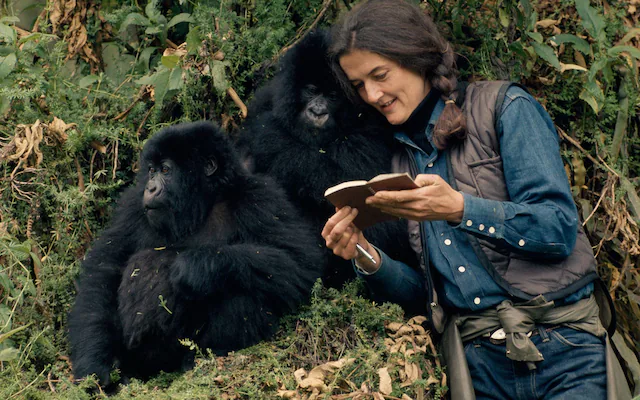
presence, allowing her to observe their daily lives at close range. This
research station would become the world's longest-running gorilla research
facility, and it remains operational today under the Dian Fossey Gorilla Fund .
Revolutionary
Research Methods
Fossey's approach to studying
gorillas was unconventional for its time. Rather than simply sitting and
observing from a distance, she actively imitated gorilla behaviors feeding,
grooming, and eventually their vocalizations, including the deep belching sounds
that signal contentment . She learned to approach them by knuckle-walking so
she would not tower over them, and she discovered that chest-beating was a sign
of alarm rather than aggression, a mistake she initially made . Her patience
and mimicry paid off: she habituated several gorilla families and demolished
the myth of gorillas as violent brutes, revealing them as gentle, social
creatures with complex hierarchies and relationships
Scientific
Contributions and Gorillas in the Mist
Over 18 years of research, Fossey
documented what gorillas ate, how they vocalized, and the intricate social
dynamics within and between groups, including how females transferred between
family units . She published her findings in the 1983 memoir Gorillas in the
Mist, which brought her story and the plight of mountain gorillas to a global
audience and was later adapted into a film starring Sigourney Weaver . Much of
what science knows about mountain gorillas today is built on the long-term
research database she began . She also allowed David Attenborough's BBC crew to
film a now-famous encounter with a gorilla family in 1979, further cementing
her work in the public imagination
Fierce
and Controversial Conservation Tactics
Fossey was not content to merely
observe. She pioneered what she called "active conservation,"
personally leading patrols to destroy poachers' traps, chase away cattle, and
lobby for expanded protected habitat . She financed four-man patrols that
destroyed 987 traps in a few months of 1979—a period during which the park's
own 24-man team failed to destroy a single one . Her methods were
confrontational: she captured and humiliated suspected poachers, burned their
camps, and publicly accused park staff of colluding with poachers . This
approach made her many enemies and drew criticism, even from her own staff, who
described her as a tough and sometimes ruthless boss .
A
Complicated Relationship With People
Fossey's dedication to gorillas
came at the cost of relationships with humans. Observers described her as
antisocial and arrogant, and her abrasive treatment of Africans, including her
own staff, has been widely documented . One porter recalled that "she
liked gorillas more than she liked people" . However, supporters caution
against judging her by modern standards, noting that attitudes toward
conservation and local communities were very different in her era . Regardless
of personal flaws, her model of intensive, daily, on-the-ground protection is
credited with being a decisive factor in the mountain gorilla's survival
The
Unsolved Murder
On December 26, 1985, Fossey was
found hacked to death with a machete in her cabin at Karisoke . She was 53
years old. The murder remains unsolved, though theories abound. Rwandan
authorities sought her research assistant, Wayne Richard McGuire, as a primary
suspect, and he was convicted in absentia by a local court, but the case has
never been definitively closed . Many believe her killing was retaliation by
poachers or others whose interests she had threatened . The mystery has only
deepened her legend.
Buried
Among Her Gorillas
Fossey was buried at Karisoke, in
the forest where she had worked, next to the grave of Digit, her favorite
gorilla, who had been killed by poachers years earlier . Around twenty other
gorillas killed by poachers or other causes are also buried nearby . Today,
visitors to Volcanoes National Park can hike to the site a trek of roughly one
and a half to three hours through the forest to see her grave and the ruins of
the cabin where she lived and died . The hike is a pilgrimage for many who
admire her work, offering a quiet moment in the place she fought so fiercely to
protect.
A
Legacy That Saved a Species
Fossey's greatest legacy is
measurable. When she died in 1985, the mountain gorilla population across its
range was estimated at around 250 to 400 individuals . Today, that number
exceeds 1,000 . The mountain gorilla is the only non-human great ape whose wild
population is increasing . The Dian Fossey Gorilla Fund, which continues her
work, now employs over 200 Rwandan staff and studies six generations of gorilla
families, including descendants of the individuals Fossey knew personally . Her
final diary entry captured her forward-looking philosophy: "When you
realize the value of all life, you dwell less on what is past and concentrate
more on the preservation of the future"
Visiting
Her Grave and Understanding Her Today
For travelers to Rwanda, the Dian
Fossey grave hike offers a chance to connect with this complicated history. The
trek begins near the park headquarters and passes through farmland and forest
before reaching the Karisoke site, where guides share stories of her life and
work . The experience is not a typical gorilla trek there are no guarantees of
seeing the animals she studied but it provides context for the conservation
success story that Rwanda's gorilla tourism represents. Understanding Fossey
means holding two truths together: she was a difficult, flawed person whose
methods would be unacceptable today, and she was also the single most important
individual in preventing mountain gorillas from extinction.